
Beyond the bright lights and roaring crowds of the stadiums lies a deeper story. To truly understand Muay Thai Bangkok stadiums, one must look at how this “Art of Eight Limbs” is woven into the very fabric of Thai life—past, present, and future.
1. A Warrior’s Heritage: The History
Muay Thai was born from necessity. In the 13th century, during the Sukhothai era, the Kingdom of Siam was constantly at war. Soldiers were trained in Muay Boran (Ancient Boxing), a battlefield art used when weapons like swords or spears were lost.
The Evolution: It transitioned from a survival skill to a sport during the “Golden Age” under King Rama V. He was a passionate supporter who established royally appointed boxing centers across the country, transforming it into a national pastime.
Symbolism: Even today, the equipment carries history. The Mongkhon (headband) and Pra Jiad (armbands) were originally talismans blessed by monks to protect warriors in battle.
2. Is it Part of Local Daily Life?
For many locals, Muay Thai is more than a sport; it is a cultural pillar and a source of social mobility.
Community Connection: In rural Thailand, Muay Thai matches are the centerpiece of temple fairs and village festivals. It is a communal event where neighbors gather to cheer for local talent.
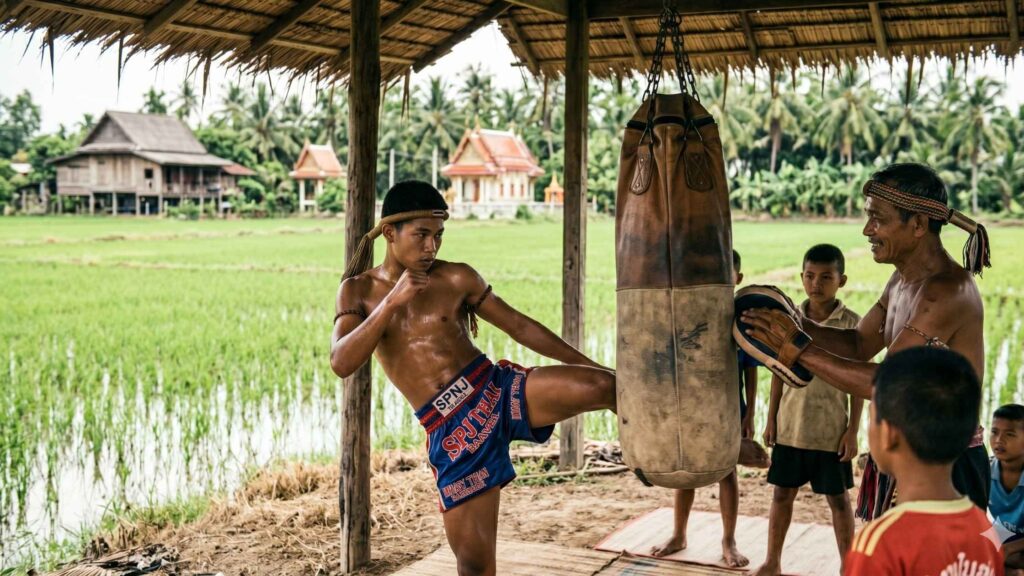
The “Lanna” and “Isan” Pipeline: Many of the champions you see at Muay Thai Bangkok stadiums come from humble backgrounds in the North and Northeast. For these young athletes, the sport is a disciplined path to providing for their families and gaining national respect.
Daily Rituals: If you walk through a local neighborhood in the early morning or late afternoon, you will likely hear the rhythmic thud-thud of pads from a nearby community gym. It is the heartbeat of the “soi” (street).
3. The Exercise Factor: A Modern Lifestyle
You don’t have to be a professional fighter to reap the benefits. Muay Thai has seen a massive surge as a mainstream fitness trend among Thai urbanites and expats alike.
Full-Body Conditioning: It is one of the most effective high-intensity interval training (HIIT) workouts. A single session can burn between 600 to 1,000 calories.
Mental Resilience: Locals use the sport to build jit-jai (inner spirit). The repetitive nature of the training fosters incredible mental focus and stress relief—a perfect antidote to Bangkok’s fast-paced city life.
Accessibility: From high-end “boutique” gyms in Sukhumvit to “hardcore” traditional camps in the outskirts, there is a training style for every fitness level.
4. The Culture Factor: Respect and Spirit
The most beautiful part of Muay Thai is the culture of Respect (Greng-Jai).
The Wai Kru: Before every fight, you will see the Wai Kru Ram Muay. This dance is a sacred ritual to pay respect to the fighter’s teacher (Kru), their parents, and their ancestors. It centers the mind and displays the fighter’s grace before the power of the match begins.
The Music (Sarama): The live woodwind and percussion music is not just background noise; it is played in sync with the fight. The tempo rises as the action gets more intense, literally “driving” the fighters forward.
Experience the Soul of Thailand
Whether you are training to get in the best shape of your life or sitting ringside at a historic stadium, Muay Thai offers a window into the Thai soul—resilient, respectful, and incredibly powerful.
Ready to see it for yourself?
Need a ride? Avoid the Bangkok traffic stress.
Message SPNJ Travel on WhatsApp and let us arrange your private transport to the arena!